
'Currently, it takes between two and three years to formulate the request for proposal for procuring specific military equipment for the armed forces. It should not be this way.'

A Pakistan that is more secure in its relations with the US is also one that might well wish to indulge in another cross-border misadventure.
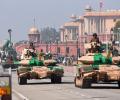
India will showcase its military prowess and rich cultural heritage on Kartavya Path in New Delhi on January 26 to mark the 76th Republic Day. Indonesian President Prabowo Subianto will be the chief guest at the event, which will also see the participation of a marching contingent and a band contingent from Indonesia. The theme of the parade is 'Swarnim Bharat: Virasat aur Vikas', focusing on the platinum jubilee of the enactment of the Constitution. The parade will feature a number of cutting-edge defense platforms, including BrahMos, Pinaka and Akash, as well as the Army's Battle Surveillance System 'Sanjay' and DRDO's surface-to-surface tactical missile 'Pralay'.
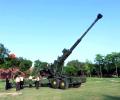
The ATAGS has a range of 35-45 kilometres, depending on the ammunition used, and achieved a 47-km firing range during trials.

10 Heroes of the 1965 War which ended on September 23 60 years ago.

'You cannot 'clear' your way to peace.' 'You need intelligence, calibrated force, impartial law enforcement, political neutrality, humanitarian returns and a sustained reconciliation plan.'
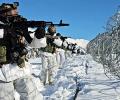
Pakistani troops violated the ceasefire along the Line of Control (LoC) in Poonch district of Jammu and Kashmir, prompting a strong response from the Indian Army. The incident, which occurred in the Krishna Ghati sector, comes a day after two Indian Army personnel were killed in an IED blast near the LoC. The ceasefire violation is the fourth cross-border incident in five days and the first this year.
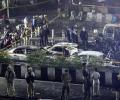
'The elimination of terrorists does not imply the neutralisation of terrorism. That terrorist ecosystem continues to thrive in Kashmir.'

What makes the Gen Z Mada movement in Madagascar significant is not only their use of digital tools but their ability to unify a disillusioned population around a shared vision of justice, transparency, and reform.
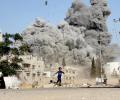
The Israeli strikes in recent weeks have affected more than one million Gazans, forcing them to vacate the area and move towards southern Gaza.
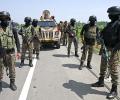
India needs to be technologically and militarily prepared to defend itself from both Pakistan and China, alerts Ramesh Menon.
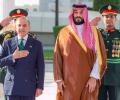
'Saudi-Pak defence pact is to anchor the defence and security of Saudi Arabia and not Pakistan, per se, with Islamabad being the junior partner.'
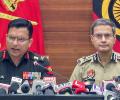
The Indian Army has demanded a fair and time-bound investigation into the assault of Colonel Pushpinder Singh Bath by 12 Punjab Police personnel. The incident occurred on March 13-14 over a parking dispute in Patiala. The Punjab Police has assured justice and set up a special investigation team to probe the matter. The Army and Punjab Police have reiterated their commitment to maintaining the long-standing bonhomie between the two forces.

'Within 30 minutes of when Asim Munir made those comments, he should have been taken to Tampa airport and flown out of the United States.'

Two army personnel, including a Lt Colonel, died and three officers were injured when a boulder fell on an army vehicle in eastern Ladakh.
'But that was not our aim. Our objective was already achieved.'
'Pakistan's army has got a streak of democracy. It is more democratic than the country.'

The situation along the Line of Actual Control (LAC) in eastern Ladakh is stable but sensitive and not normal, Chief of Army Staff General Upendra Dwivedi said on Tuesday on the dragging military standoff between China and India in the region.
The Trump administration said it will conduct a "rigorous" re-examination of all Green Cards issued to immigrants from "every country of concern".

The Pakistanis were so fearful of Brigadier Mohammad Usman, the 'Lion of Naushera', that they announced a Rs 50,000 bounty on his head.
'Munir is clearly insecure and hence he needs the prop of a field marshal.'
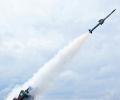
Glimpses from India and around the world that will make you smile and cry.

The US sees an opportunity to expand its strategic relationship with Pakistan but assures that it will not come at the expense of its ties with India, according to US Secretary of State Marco Rubio.

The Indian armed forces will conduct an exercise to test the capabilities of its drones and counter-drone systems. The exercise, named 'Cold Start', will involve all three services and will take place in Madhya Pradesh.
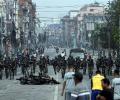
The representatives of youth-led Gen Z, which spearheaded the anti-government protests, held meetings with the top military brass to finalise a transitional government, but the talks hit a roadblock on the issue of who will head it.
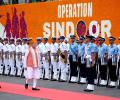
The bilingual -- Hindi and English -- invitation cards for I-Day anniversary celebrations carry this image on the top right corner of the invite, while the silhouetted image of the Chenab bridge, the world's tallest railway arch bridge, sits at the lower side of the cards, which have largely being issued online via 'Aamantran' website of the Ministry of Defence.
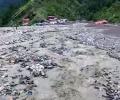
Rescue operations continue in Uttarkashi after flash floods, with dozens still missing. The Army and other agencies are working to rescue stranded people and restore connectivity.

Among the 24 injured are 14 civilians, including women and children, with several said to be in critical condition.
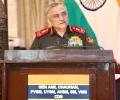
Gen Chauhan said a "whole of the nation" approach will be required to develop the shield.

'Shock, confusion, and paralysis reigned.' 'Pakistan was caught in a most embarrassing situation. It could neither claim credit for the operation nor admit to a dismal intelligence failure and lack of army preparedness.'
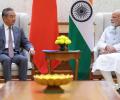
Former Army chief Gen M M Naravane (retd) said India-China ties are "on the mend" with initiatives announced at political, diplomatic and military levels. He expressed hope that China will reciprocate India's goodwill as they move forward in discussing the boundary question.
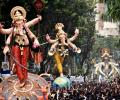
Glimpses from India and around the world that will make you smile and cry.
'There are only a few countries in the world that have deployed combat-ready laser systems.'

Chief of Defence Staff Gen Anil Chauhan identifies China border dispute as India's biggest national security challenge, followed by Pakistan's proxy war. He also highlighted regional instability, future warfare scenarios, and dealing with nuclear-armed adversaries as major concerns.
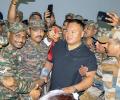
Naib Subedar Hokato Hotozhe Sema, a bronze medalist at the Paris Paralympics 2024 in the Men's Shotput F57 final, expressed his gratitude to the Indian Army for their unwavering support and motivation throughout his journey.

The Indian Army has commenced a verification patrolling at Depsang, the second friction point in eastern Ladakh, the government said on Saturday.

The commanders' conclave in a forward area in Sikkim, which is close to the Line of Actual Control, comes amid the lingering border row in eastern Ladakh.

China displayed a range of new weapons at a military parade, including laser weapons, nuclear ballistic missiles, giant underwater drones, and fifth-generation aircraft.

Army jawan Kapil Panwar, who was brutally assaulted by toll plaza staff in Meerut, expresses his distress over the incident, while authorities take action against the toll operator and arrest suspects.

Vice Admiral Li Hanjun, chief of staff of the People's Liberation Army Navy (PLAN), and Liu Shipeng, deputy chief engineer of China National Nuclear Corporation, have been expelled from the National People's Congress (NPC), the Hong Kong-based South China Morning Post reported.
